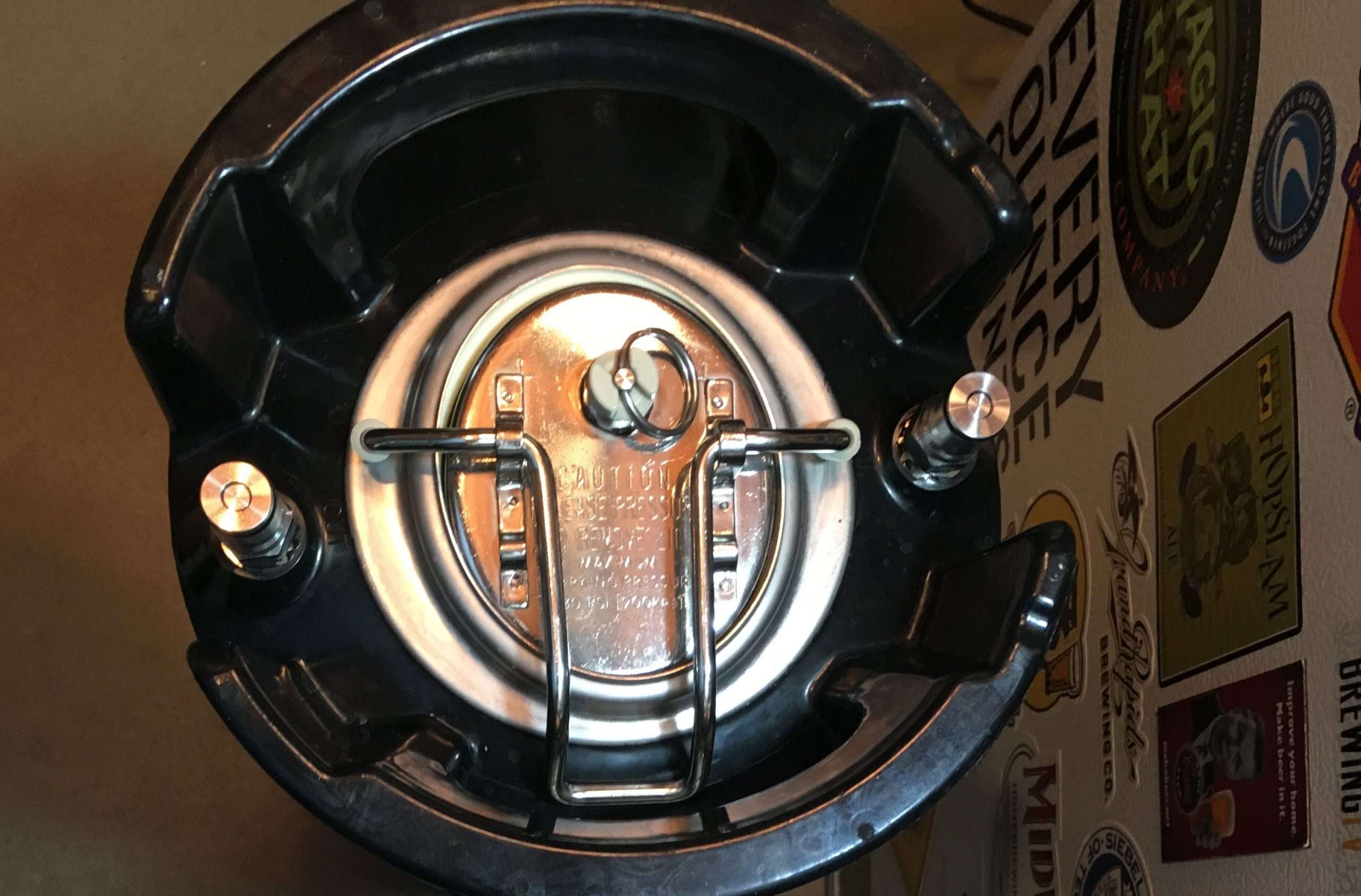
Ball Lock
One benefit of owning a ball lock keg is that they are still being manufactured currently and, because of this, the parts for these kegs are a lot easier to find. You will also notice a manual pressure release valve on the lid, this allows you to quickly and easily release the pressure so you can open the keg for cleaning or refilling. Since we only purchase new kegs that haven't been used previously, all Tint Kegs are ball lock kegs.
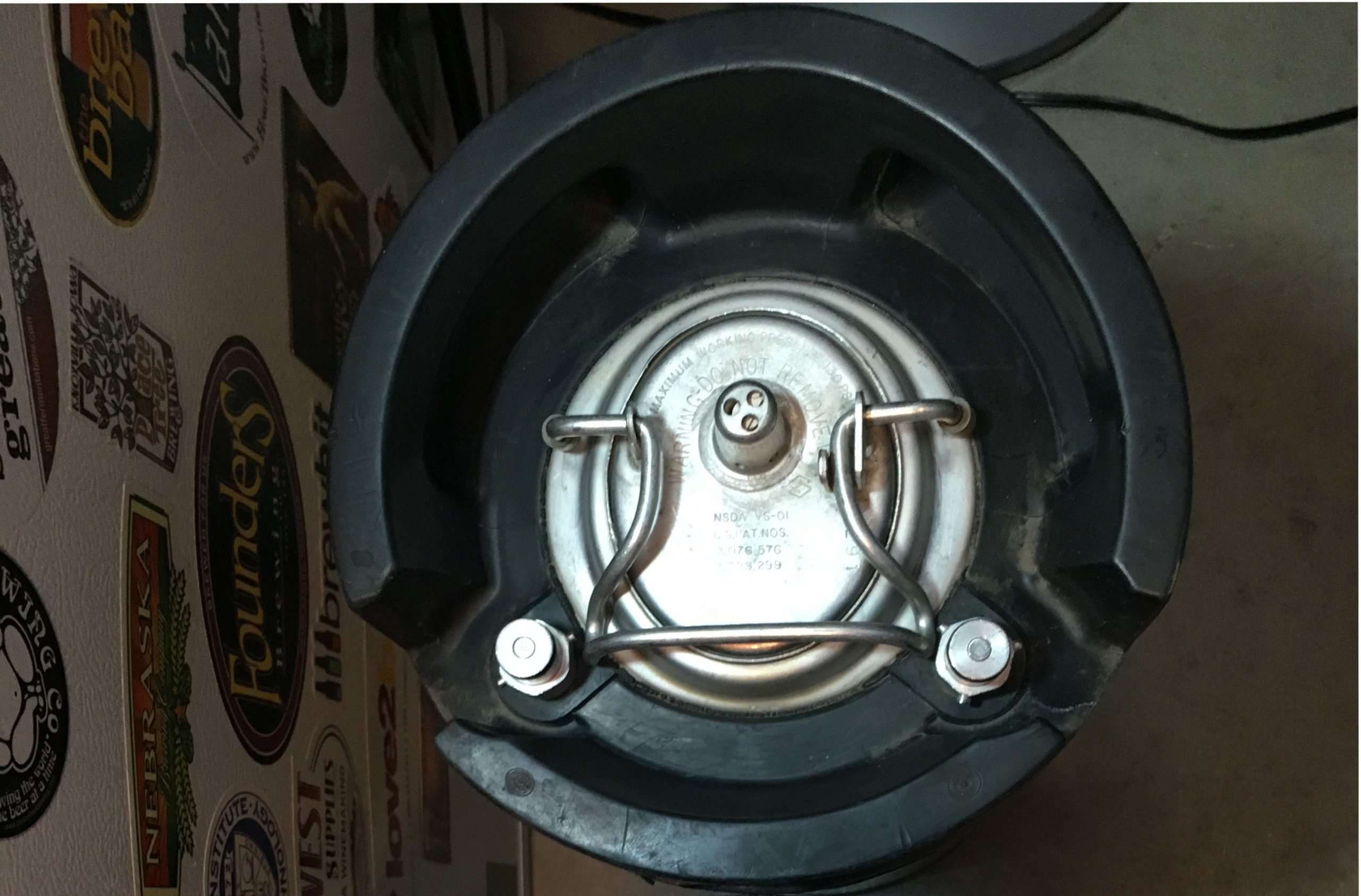
Pin Lock
If you look closely at the posts you will see where the pin lock keg gets it's name from. There are 2-3 small pins coming out from the sides of the post. Pin lock kegs stopped being manufactured sometime in the 80's. They were originally used for soda. You may also notice the pressure release valve lacks a way for you to manually release the pressure. There are accessories that can be purchased to remedy this problem or you can buy a new lid.
(Thank you to Homebrew Finds for these photos)
The Difference in Pin Lock Kegs

Thank you to Corny Keg for this picture
There are right around 15 different variations of pin lock kegs. Here, we will be primarily focusing on how to determine which pin lock keg you have. In general, pin lock kegs will have either 9/16″ – 18 threads or 19/32″ – 18 threads. There are some that do not adhere to this rule, but the vast majority do. If your pin lock keg has either of these threads it can be converted to a ball lock keg which may be extremely beneficial to you because, as previously stated, parts are more widely available for ball lock kegs.
Firestone/Spartanburg Kegs
One of the easiest ways to identify if you have a Spartanburg/Firestone keg is to simply look at the rubber top of the keg. If the circle is complete with no breaks, it is likely a Spartanburg/Firestone. If you would like to take things further, you could test the threads on your In and Out posts by removing them and purchasing a 9/16” – 18 nut and see if it will screw on where you took your posts off. In most cases, your Out (Liquid) post will have 3 pins and your In (Gas) post will have 2 pins.
Cornelius Kegs
Similar to the Firestone/Spartanburg kegs, you can also look to the rubber top of your keg to determine if it is a Cornelius Keg. On a Cornelius keg, the rubber top will have two “breaks” or “notches”, one at each post. You can also test the thread sizes on these kegs as well to determine the thread sizing. If both posts are 19/32” – 18 then your keg is indeed a Cornelius keg. (You might have a hard time finding a 19/32 – 18 nut so you might look to Amazon for this one.)
While the vast majority of kegs will fit into one of these two categories, there are many variations, so it is entirely possible that your keg is different. Some other variants are as follows:
- Firestone V Challenger, Firestone VI Challenger, Firestone Super Challenger – Liquid Post: 5/8” – 18, Gas Post: 9/16” – 18
- John Wood 85, Firestone Challenger – Liquid Post: ¾” – 8, Gas Post 11/16” – 18
The Difference in Ball Lock Kegs
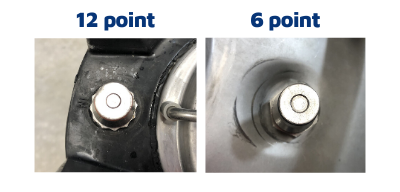
(Thank you again to Homebrew Finds for this picture)
Luckily, ball lock kegs do not have the seemly endless amounts of variants that the pin lock kegs do. There are three main ones and a few additional options that are extremely uncommon.
Post Size
Ball lock kegs will typically have either an 11/16” post or a 7/8” post. Each size is also available in either 6 point or 12 point versions. The 11/16” posts are available in 12 point but they are extremely rare.
Thread Size
As far as threads are concerned, you can test your thread size in the very same way that you would test your pin lock keg thread size. 19/32” – 18 are by far the most common.
Other Uncommon Thread sizes:
- 5/8” – 18
- ¾” – 18
- 9/16” – 18
- 11/16” – 18
All Tint Kegs have 6 point 11/16” posts with 19/32” threads.